

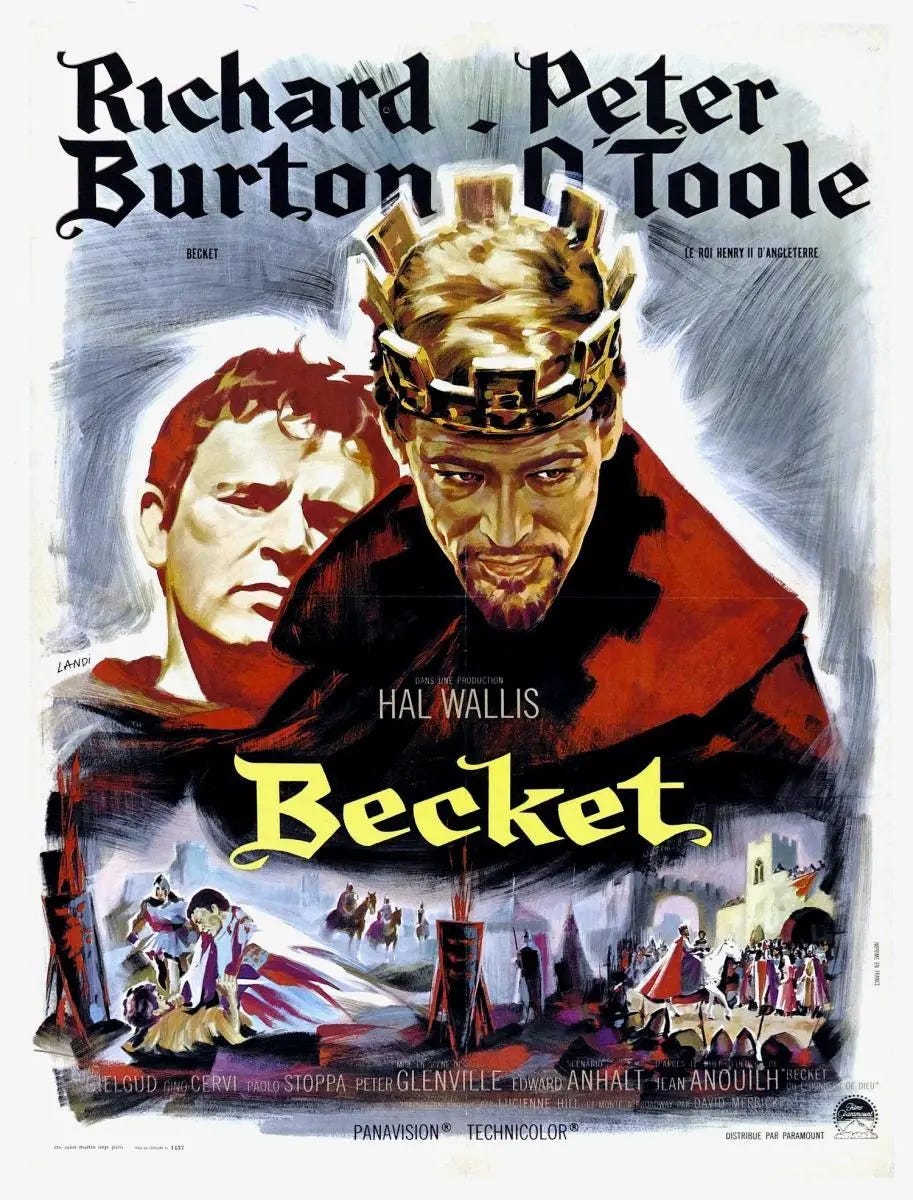
Becket begins nearly a century following the conquest of the Saxons by the Norman King William the Conqueror. Becket (Richard Burton) is a lowly Saxon living under Norman occupation of England, yet somehow, he has befriended William the Conqueror’s grandson, Henry II (Peter O’Toole).
Henry is a playboy and a theatrical, impulsive ruler: he plunges into cold baths after sleeping with peasant girls, gets toweled off by his best friend Becket, and demands money from Catholic clergy for a campaign he wants to wage against the kingdom of France. By contrast, Becket, Henry’s right-hand man, is cerebral and restrained. He is not a court jester, nor is he a prisoner; he is elevated to Lord Chancellor by Henry. As Sam loves Frodo, Henry loves Becket. Unlike Sam/Frodo, Henry makes demands in return for his show of love towards Becket.
Becket is loyal to a fault. When Henry requests Becket’s concubine/girlfriend/wife Gwendolyn, Becket permits it, much to Gwendolyn’s disappointment. More loyal to the King of England, Becket cannot refuse the King’s request, and worse, remains immovable to Gwendolyn’s plea. Gwendolyn kills herself in Henry’s bed moments later.
When the archbishop of Canterbury dies suddenly, Henry appoints Becket to the role. Becket is ordained despite his resistance. Henry expects a figurehead within the church that will help him do his bidding, but a shift occurs deep within Becket’s soul. Although he does not suddenly become warm and gentle, he takes the role seriously.
Becket’s heart is moving closer to God, and away from loyalty to Henry. The breaking point comes when a priest is accused of sexual indiscretions, arrested and executed by civil authorities. Becket uses his authority to excommunicate one of Henry’s loyal supporters, Lord Gilbert. A scorned lover, Henry is humiliated when Becket no longer gives him complete allegiance, and a political cat-and-mouse game follows.
Becket cleverly evades capture numerous times. He finds refuge in France and seeks counsel from the Pope. In doing so, it becomes clear that his faith demands sacrifice, and his destiny is martyrdom. Becket is killed by barons faithful to Henry as he celebrates Mass at Canterbury.
Once begun, the path to sainthood only becomes harsher. Becket relinquished influence, power, friendship and finally, his own life. But he did not die because he was weak or naïve. He died because once given, he would not take back his loyalty to God. Though afraid of death Becket accepted it gladly, as he followed the example set forth by Christ’s crucifixion.
Years later, Henry admits his wrongdoing, is whipped for penance and declares that Becket will be canonized, and his murderers justly punished.
A medieval happy ending.