

I submitted this to Magazine Non Grata but never got a response, so I’m publishing it here. If they do run it in their next issue, I’ll take it down.
…
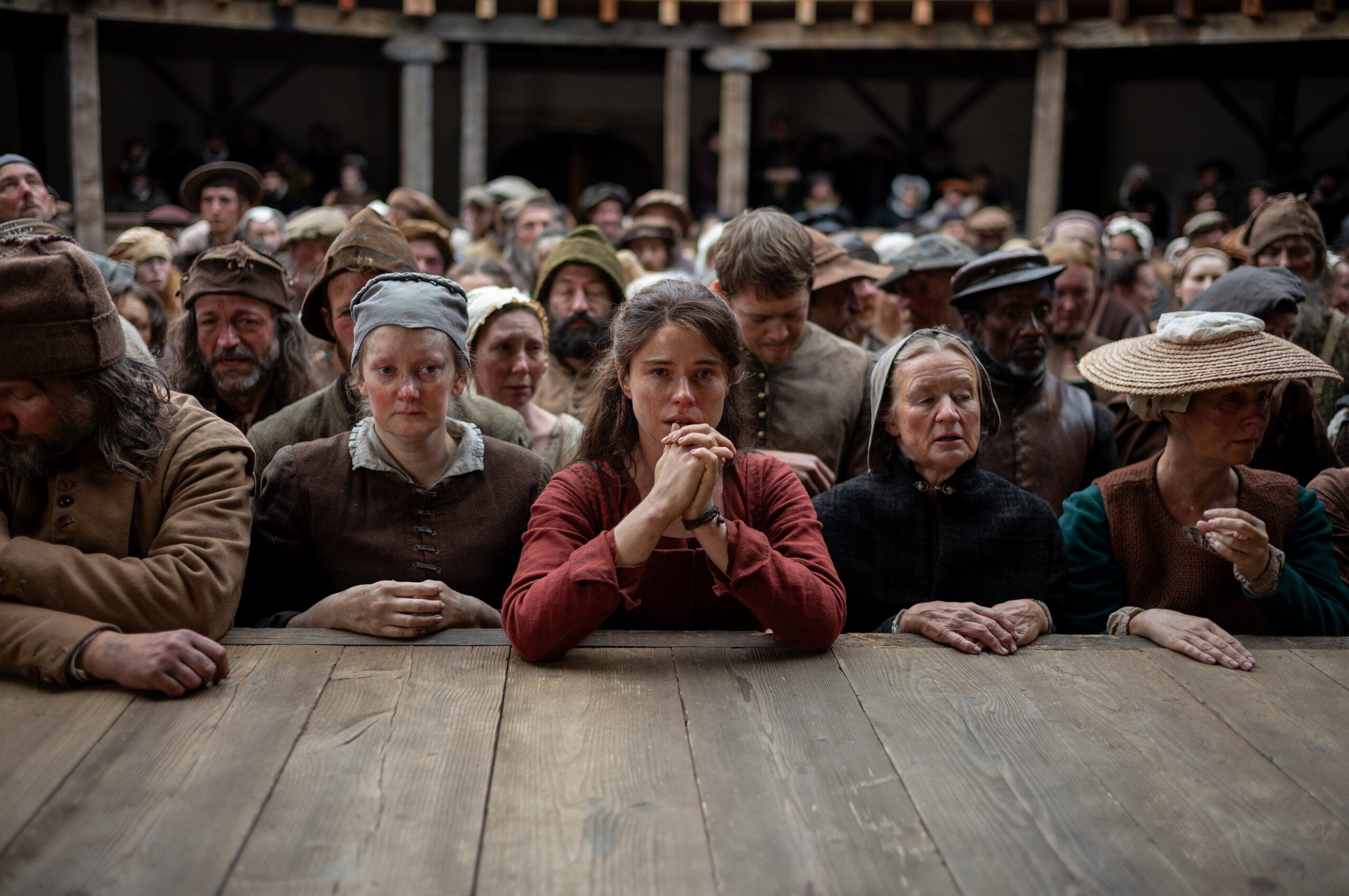
Hamnet has all the ingredients necessary to win the Oscar for Best Picture: a historical drama (check) about the death of William Shakespeare’s 11-year-old son, Hamnet (check) based on Maggie O’Farrell’s book “Hamnet: A Novel of the Plague” (check), and directed by the female Best Director of Nomadland, Chloe Zhao (check). Cinephiles, anglophiles and fan girls everywhere salivate at this fondant covered cake of a film.
While tutoring students in Latin to decrease his father’s debt, a young William Shakespeare notices Agnes Hathaway practicing falconry and leaves his students mid recitation to follow her. Shakespeare is a handsome romantic, and their love begins to bud despite renouncement from both of their families. Agnes conceives his child out of wedlock, and they happily marry. Shakespeare spends long nights writing, and his anguished outbursts during the creation process wake the baby. Genius like his comes once every 500-700 years, and it cannot be cooped up in Stratford. Agnes urges him to travel to London to produce his plays, and he splits his time between Stratford and London.
Though still a coherent family after his departure, their stories diverge; Shakespeare is absent for stretches as Agnes raises their first child. Years pass in moments, and she is pregnant again, giving birth to twins Hamnet and Judith.
Shakespeare is absent from the dramatic birth of the twins, and the film begins to lose focus. Events are linked thematically, but narratively disjointed. Shakespeare rehearses his new play; Agnes raises the children. The film seems unsure which character to tell its story though: Agnes or Shakespeare. Is it a story about the death of a child? Or a marriage strained by genius and distance?
The plot splits its attention between Agnes and Shakespeare, with Hamnet a minor character as a shared prop. While they remain a coherent family emotionally, the film cannot reconcile their parallel stories into a single dramatic arc. Time passes in montages of Shakespeare’s visits home and his relationship with his growing children. Emotional weight is shown in beautiful shots, not told with dialogue.
But this is the film’s central contradiction: it asks us to feel the unbearable absence of Hamnet without first making him present. Yes, he is “just a child” when he dies. The audience needs to know Hamnet not as a symbol, not as a future corpse, but as a person. Instead, he enters the film halfway through amid his parents’ own lives until he must die of the plague.
The film relies heavily on atmosphere to compensate. The montages are scenic and carefully composed. The forest is reverent, hushed, almost sacred. The camera lingers on nature. Hamnet shows rather than tells, and this restraint can be powerful. The dialogue is sparse, often replaced by slow panning shots. This strategy demands a perceptive audience.
But restraint only works when the emotional stakes are already established. Here, the plot hinges entirely on Hamnet’s death, which means that death must land with force. At least to feel empathy with Shakespeare. Instead, the moment arrives abruptly. Judith falls ill and Hamnet takes the sickness from her. The tragedy does not grow with clues to the looming plague. Agnes’s grief is overdramatized, loud and wailing.
Hamnet needed to decide which Oscar movie it wanted to be: Shakespearean fan fiction about genius and legacy, or a story about the death of an otherwise unknown child, who also happens to be the bard’s only son. It tries to be both and blunts each.
In Maggie O’Farrell’s novel, the plague is practically a character; it is mentioned in the novel’s subtitle! But in the film, the plague feels unknown, like a deus ex machina. In London, Shakespeare lives in its shadow, yet it never truly enters the plot as a threat. Perhaps its presence is meant to be subtle. Perhaps I missed it. But if the plague is the engine of the story, it needs more presence.
Ultimately, Hamnet is more a vibe movie than a plot movie. It is meditative, its shots are painterly. It is concerned with mood and texture. That approach would have been more powerful if Shakespeare were decisively the central character, rather than competing for narrative dominance with Agnes. A film more focused on Shakespeare’s distance from his family as he balanced his career and legacy, returning to a home altered by plague might have allowed Hamnet’s loss to be more felt. Instead, the film leans heavily on the deathbed scene itself, asking it to carry the emotional weight that earlier scenes declined to build, instead focusing on Agnes.
And yet, the ending nearly redeems everything.
Shakespeare performs as the ghost of Hamlet’s father, with Agnes in the audience. He speaks through a role, through his art and immortalizes his son. He says on stage through character what he cannot say directly. This is the moment when the film aligns perfectly with its subject. If Shakespeare kept a diary, it did not survive time. He expressed himself through his plays. His grief at all, he did so in verse, in the characters who speak for him. This scene understands that truth.
For all its flaws in storytelling and character cohesion, Hamnet absolutely nails the climax. I just wanted to feel the same grief Shakespeare felt.
Probably a good thing I didn’t.